date
8 April 2016
closed
location
hồ chí minh
program
+1 contemporary project
about
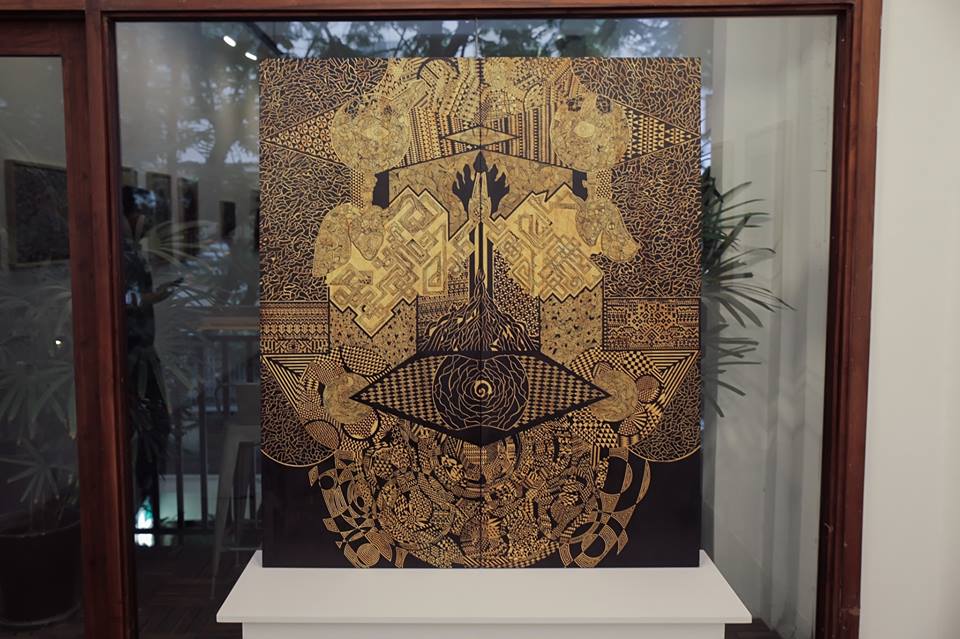
Tuyp Tran (Tran Quoc Huy, b. 1988) is a self-trained Vietnamese visual artist. His oeuvre encompasses food, sex and spirituality among various other topics. What connects these seemingly disparate subject matters, according to Tuyp, is the human psyche. In Ramen Girl, similar to Tuyp’s other cuisine-themed pieces, a savory meal is placed at the centre. A vertical cascade of noodles bridges between the girl’s gobbling mouth and her appetizing noodle bowl. The power of Tuyp’s work lies in not only the mundane choice of subject matter but the obsessive level of detail. Discerning viewers could notice the punctilious details around the fringe of the ramen bowl, such as images of birds in flight, dancing girls with elaborate headwear or floating koinobori (Japanese carp streamer) among other motifs and symbols. At the bottom, curved roofs appear in a horizontal skyline of ancient Vietnamese houses, gates and temples. Is there a deliberate juxtaposition between the humble architecture of the provincial past and a modern diner of the global present? What
about the patterns in the background are they derived from Vietnamese ethnic minorities' textiles or some foreign design? Why does most of the girl’s body bleed, if not disappear, into the background, leaving only the chopstick- holding hand, robotic-looking arm and gorging mouth visible? Tuyp’s illustrations certainly evoke more questions than answers. Besides the presentation and consumption of delectable food, Tuyp also revels in flavors of human bodies. In Tropical Fever we have a circular band of five faceless females standing, kneeling and crouching erotically. Supposedly inspired by ”a night in Bangkok” according to the artist, the image of women dancing in stilettos and swimming in buzzing colors brings to mind the familiar night-club decadence of urban society. At first glance, the scene might be construed simply as a male fantasy but the female bodies might represent something beyond sexual imaginings. The women pose in a circle among images of birds and fish, trees and reeds, which creates a playful space in which the female body harmonizes with nature’s feverish vitality, instead of being objectified by the male gaze. Tuyp tends to not romanticize but intensify female power. Commenting on Vortex Pussy, Tuyp argues it is female sexuality that could “destroy the world of man.” The vagina is portrayed as a vortex of bivalves, attracting a whirling mass of phallic shapes. The female body could either be the epitome of vivacious life or a destructive black hole that endlessly ingests men. Tuyp bypasses gender politics and turns to provocative and sensual figures to compulsively visualize concepts and questions drifting in his restless mind. Tuyp’s collection is reminiscent of a young man’s acid trip into the recesses of the subconscious. From afar, his works resemble a baffling explosion of vivid colours and intertwined designs. Claiming no ready made meaning each detail a memento from deeply personal experiences and ineffable sensations the artist hopes to simply “provoke ideas”; from his audience by visually tapping into the collective unconscious. He gives the viewer total freedom to interpret, and prefers us not to pigeonhole him into one contrived genre or another. Tuyp delves into a diverse range of subject matter, including not only food and bodies but also religion (Rage of God), Western-influenced youth culture (Hipster) or totem images (Tribal Status). What to make of this intriguing melting pot is up to the viewers’ capacity to stay open to what Tuyp calls "the deepest corner of the mind […] the unexplainable." Tuyp’s life sized ink on wood piece, Channeling, visualizes this profound dream of psychological unity. Two giant talking birds converge at the center, not in a combative stance but a calm moment of mirroring. It is the artist’s desire to see his internal oppositions no longer clash, but come together for a conversation, an understanding that requires no human language. The two creatures inside the artist do not identically mimic each other but their components such as the beaks, lungs and intricate plumage have found a common somatic rhyme and flourishing symmetry. As Tuyp’s largest, most gripping and most ambitious piece to date, Channeling evokes that universal dream to have our inner contradictions miraculously reconciled in a still moment of poetry and wholeness. A review by Quyen Nguyen
Location: 103 Dong Khoi, District 1, Ho Chi Minh City
documentation